The Importance of Nakshatras in Life: What Are Nakshatras and How Do They Influence Us?
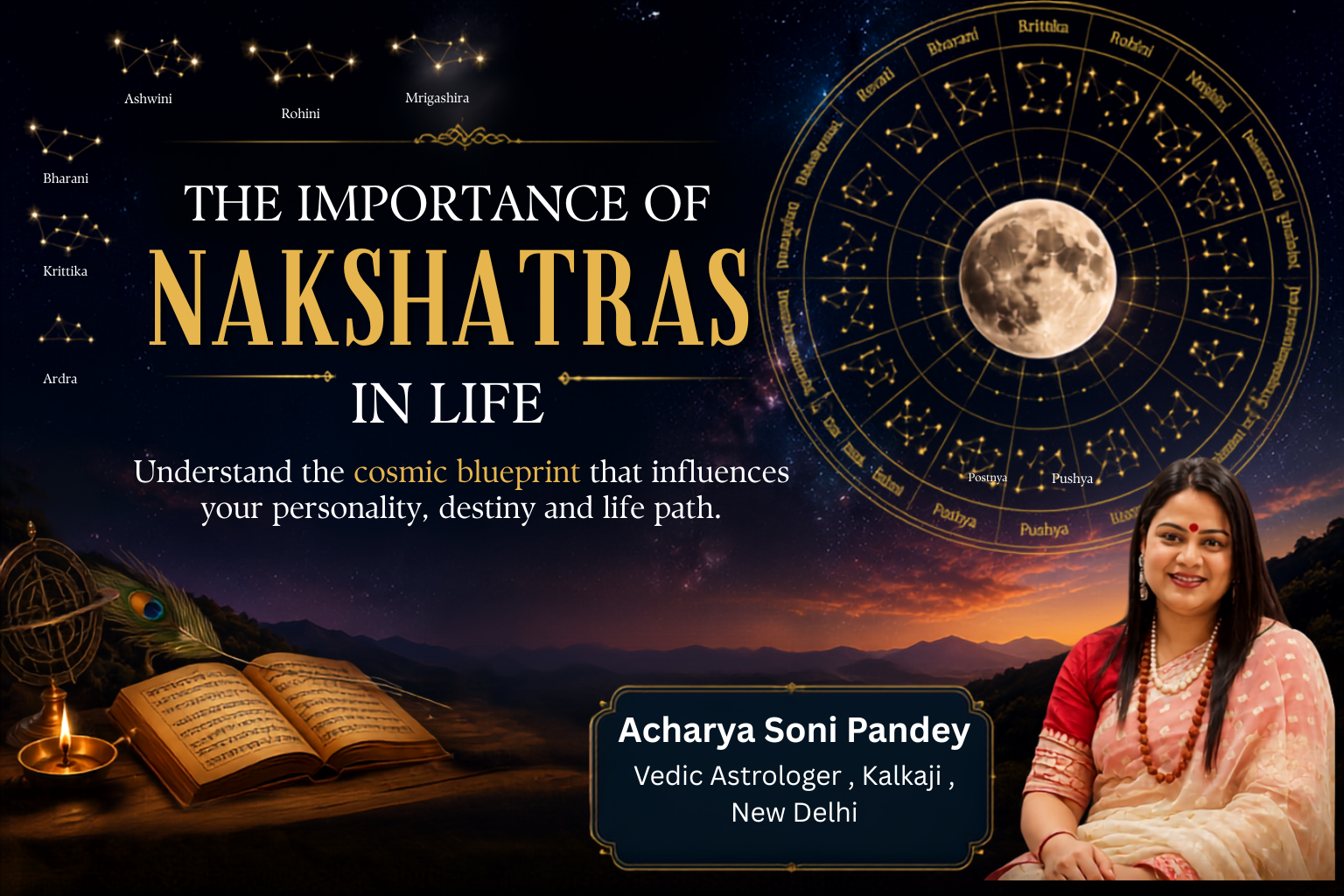
The Importance of Nakshatras in Our Life: What Are Nakshatras and How Do They Influence Us?
Nakshatras occupy a central place in Vedic Astrology. From the moment a person is born to important life events, auspicious timings (Muhurtas), and detailed horoscope analysis, Nakshatras play a significant role in understanding an individual's life journey.
Many people often ask:
What exactly are Nakshatras? Are they simply groups of stars, or do they have a deeper connection with astrology and human life?
In this article, we will explore Nakshatras from both the Vedic perspective and the viewpoint of modern astronomy.
What Are Nakshatras?
The Sanskrit word Nakshatra refers to a celestial division of the sky that has traditionally been regarded as fixed.
From the perspective of modern astronomy, Nakshatras are closely associated with constellations, or recognizable groups of stars visible in the night sky.
Ancient Indian sages carefully observed these star groups and divided the lunar path into 27 Nakshatras, creating one of the world's oldest celestial mapping systems.
What Is a Birth Nakshatra?
According to Vedic Astrology, the Nakshatra occupied by the Moon at the exact time of birth is known as the Birth Nakshatra (Janma Nakshatra).
The Birth Nakshatra serves as an important reference for:
Horoscope interpretation
Planetary Mahadasha calculations
Muhurta selection
Traditional Vedic rituals
Personality analysis
Because the Moon represents the mind and emotions, the Birth Nakshatra is considered highly significant in Vedic astrology.
Are Nakshatras the Same as Stars?
Not exactly.
This is one of the most common misconceptions.
Nakshatras are not individual stars. Instead, they are celestial sectors identified by specific groups of stars (constellations).
For example, the famous Saptarishi Mandala corresponds to Ursa Major, one of the best-known constellations in modern astronomy.
How Are Stars Formed?
Modern astronomy explains that stars originate from enormous clouds of hydrogen gas and cosmic dust.
Under the force of gravity, these clouds gradually collapse to form a protostar.
As the core temperature rises, nuclear fusion begins, converting hydrogen into helium and releasing an enormous amount of energy.
This energy appears as the light and heat emitted by stars, including our own Sun.
Do Stars Have a Life Cycle?
Yes.
Like all celestial bodies, stars are born, evolve, and eventually die.
Over millions or even billions of years, they pass through different stages such as:
Protostar
Main Sequence Star
Red Giant
White Dwarf
Supernova (for massive stars)
Although stars appear permanent to the human eye, they are constantly evolving over astronomical timescales.
Do Stars Emit Radio Waves?
Yes.
Astronomers have discovered that certain celestial objects emit powerful radio waves.
In the late 1960s, scientists detected highly regular radio signals from rapidly rotating neutron stars, initially leading to speculation about extraterrestrial intelligence.
These objects were later identified as Pulsars, a remarkable stage in the life cycle of massive stars.
Relationship Between Nakshatras and Zodiac Signs
In Vedic Astrology, the celestial sphere is divided into:
27 Nakshatras
12 Zodiac Signs (Rashis)
A person's Birth Nakshatra is determined by the Moon's position, while zodiac signs are based on the positions of the Sun and other planets.
Together, these two systems provide a more detailed framework for astrological interpretation.
Why Are Nakshatras Important in Vedic Astrology?
Nakshatras are not viewed merely as tools for prediction.
Instead, they help astrologers understand various aspects of an individual's life, including:
Personality traits
Mental tendencies
Decision-making patterns
Emotional nature
Life timing
Spiritual inclinations
They provide a deeper layer of analysis beyond zodiac signs alone.
A Balanced Vedic Perspective
According to Acharya Soni Pandey, Nakshatras should be understood as an integral part of India's rich Vedic knowledge system rather than as instruments of fear or superstition.
A thoughtful study of Nakshatras helps individuals understand themselves better, make informed decisions, and appreciate the harmony between cosmic rhythms and human life.
The purpose of astrology is not to create fear, but to inspire self-awareness, clarity, and personal growth.
Conclusion
Nakshatras form one of the most fundamental pillars of Vedic Astrology.
Modern astronomy studies them as constellations and celestial structures, while Vedic Astrology interprets them as important markers for understanding time, planetary influences, and human tendencies.
Together, these perspectives reveal that Nakshatras are not merely symbols of ancient tradition but also represent a fascinating bridge between astronomical observation and India's timeless wisdom.